
Photo by Holly Webb
I have decided to conduct some additional research to learn more about shooting in RAW.
I feel as though I will be more comfortable shooting in RAW if I know the technicalities behind it and understand the benefits of it first – I’ve always been like this with learning new things.
Although I definitely want to try shooting in RAW for my project, this research will hopefully confirm whether I want to shoot in JPEG at all:
Shooting in RAW
RAW is a file format that records all data when the camera captures the photo – with JPEGs, the image is compressed to save space and some of the information is lost. This is why JPEGs are good for sharing online, or emailing to friends, but when it comes to editing a lot of the information got rid of to save space is actually important.
Because no information is compressed, RAW allows higher quality images, and you are able to correct problems that would be unrecoverable in JPEG.
When you shoot in JPEG, the camera is technically shooting in RAW, but does it’s own processing to convert the file to a JPEG.
When you shoot RAW, you’re able to do the processing yourself. You can make the decisions on how the image should look, and produce better results.
Shooting in RAW is a choice for this module, so I decided to learn more about the differences to ensure I obtain the best images for my project.
Benefits
- higher quality image
As said above, less data is lost so the post-production process produces higher quality images.
- records greater levels of brightness
The more levels of brightness an image captures, the smoother the transitions in the image. JPEG records 256 levels of brightness, shooting in RAW records between 4,096 and 16,384. This has a large impact on the image as you can work with more layers of brightness – therefore making more adjustments to your image without losing any image quality.
- you can easily correct exposure
Because the camera picks up more data, it is easier to correct over/under exposure when shooting in RAW. All the while, not losing any image quality.
- you can easily adjust white balance
With all images, white balance is applied. When shooting in RAW however, you have more data meaning it is easier to adjust the white balance without – again – losing image quality.
- better detail
When you shoot in RAW you can access to sharpening and noise algorithms in programs like Lightroom that are much better than those found in cameras. Plus, these tools are always improving, so in theory you could go back to your RAW files and improve them even more in the future.
- editing is non-destructive
With RAW files, editing isn’t actually doing anything to the original data. This means you never have to worry about ruining an image as you can reset your adjustments and always start over again. Everytime you open, edit and resave a JPEG, the image loses quality, so when you’re editing JPEGs you should duplicate and save out a new version every time you edit to avoid losing quality, and that’s hassle. 🙂
- better prints
With RAW images, it is easier to correct and avoid banding in prints.
- easier and quicker workflow
Programs like Lightroom are designed to make it easy to work through large batches of images. Photoshop is only really designed to edit one image at a time. To take advantage of these features, you should shoot in RAW.
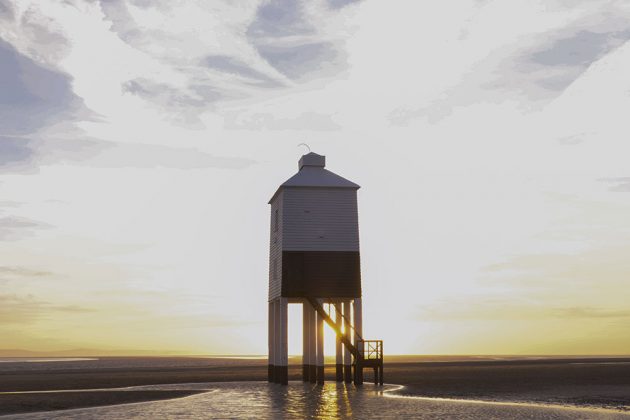
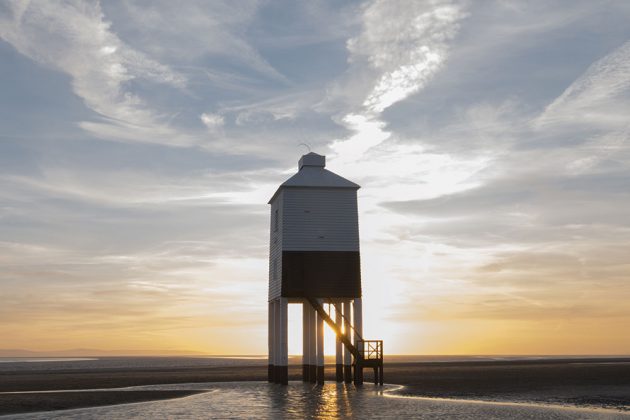
The following images show the difference between RAW and JPEG. The same subject was shot, in both RAW and JPEG formats and it was overexposed. When the photographer came to correct the overexposure, and you can see how much more information is in the RAW file, as the detail is kept. It is much easier to ‘fix’ a RAW file:
Disadvantages
- need to be processed
You always have to process RAW files. So if you don’t have the time then shooting in JPEG makes more sense, however many people end up processing JPEG files anyway so it is only a disadvantage to people who don’t do any post-production on their images. Also, in some cases the post-production stage with RAW files is even faster than with JPEGs.
- takes up more space
Because of all the data kept in a RAW file, they are usually much larger.
- slows the camera down
Because RAW files are much larger, they can fill up your buffer quicker. People who want to shoot large sequences of RAW images usually buy faster memory cards or more expensive cameras. 😦 If capturing ‘the moment’ is the most important to you, then RAW might not be the one.
- you can’t upload them online
With RAW formats, different cameras have different formats. For example, a RAW file on a canon would appear .CR2 on the compute, and a Nikon RAW file would be .NEF. Because they’re not universal, RAW files can’t be uploaded online or share them with friends. They have to be processed and exported first.
- turnaround time
For example, if you need to get images to a client as soon as possible, there may not be time for the post-production that comes with RAW. Some press shoot in JPEG to get the images to their client as quickly as possible.
Because of these advantages and disadvantages, shooting RAW is helpful when:
- shooting portraits
- there’s a risk of over/under exposure
- the white balance is off
- you have to enlarge the image or print it
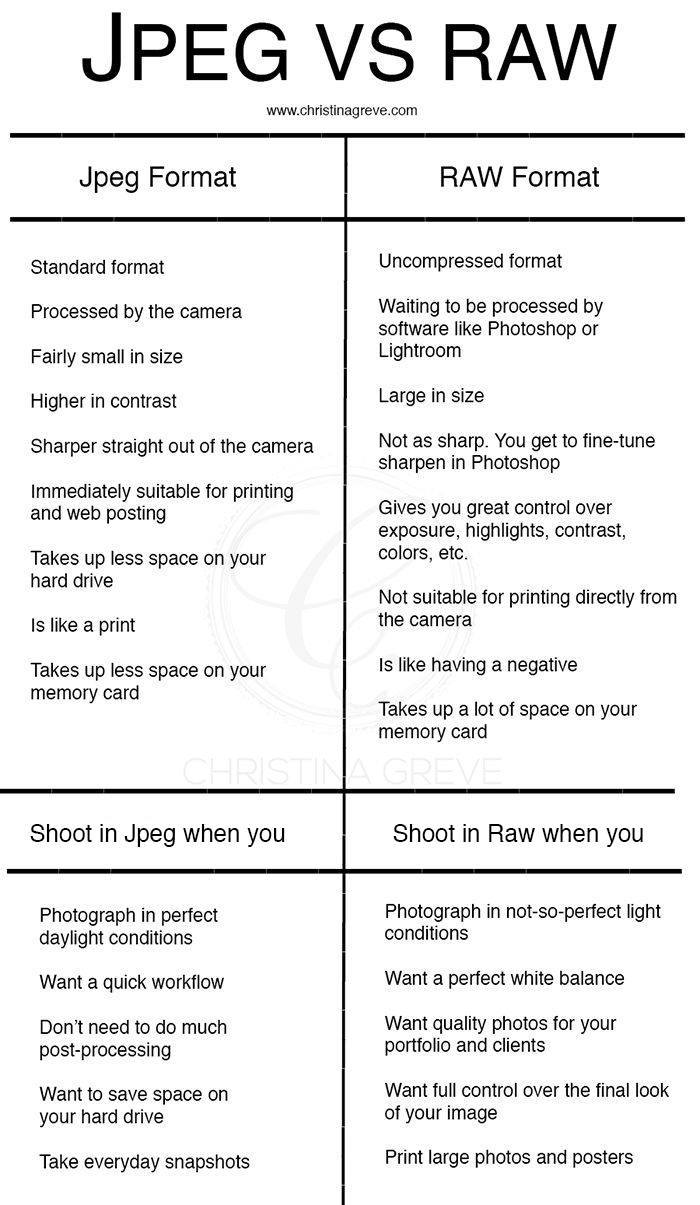
To sum up this research, photographer Christina Greve created this table:
My project:
After learning more about RAW format, I think I will definitely be shooting in RAW for my project as my camera has the ability to do so.
It is a choice for this module – as high resolution JPEGs are accepted – however after looking over the positives and negatives, I don’t see any reason to not shoot in RAW.
The only major negatives for shooting in RAW include the turnaround time, and it not being suitable for bursts of photos (eg. sports photography).
Although I haven’t yet decided on my project title, I know that I want to include portraiture, as well as candid photography. Because of this, I don’t see why I shouldn’t shoot in RAW as I am not planning on shooting large numbers of shots at once.
I’m also not concerned about the turnaround time as I will be shooting my images far in advance to spend a lot of time in post-production choosing my favourite images and making sure I edit them to look as good as possible.
In every other situation, RAW trumps JPEG. The great advantage RAWs give me is a safety net almost. For example if I can’t work out the perfect exposure, or set the white balance properly, I have the knowledge that these things can be tweaked later with greater room for editing than would be possible with a JPEG.
Aims for this week:
- to practice shooting in RAW
- to practice post-production with the RAW images
- publish blog post with my before and after RAW-format images
Some of the articles I read:
photographyconcentrate.com/10-reasons-why-you-should-be-shooting-raw/
www.findingtheuniverse.com/what-is-raw-in-photography/
www.amateurphotographer.co.uk/technique/everything-need-know-shooting-raw-106356
christinagreve.com/jpeg-raw-beginners-guide-start-shooting-raw-image-mode-easy/
 webbphoto