
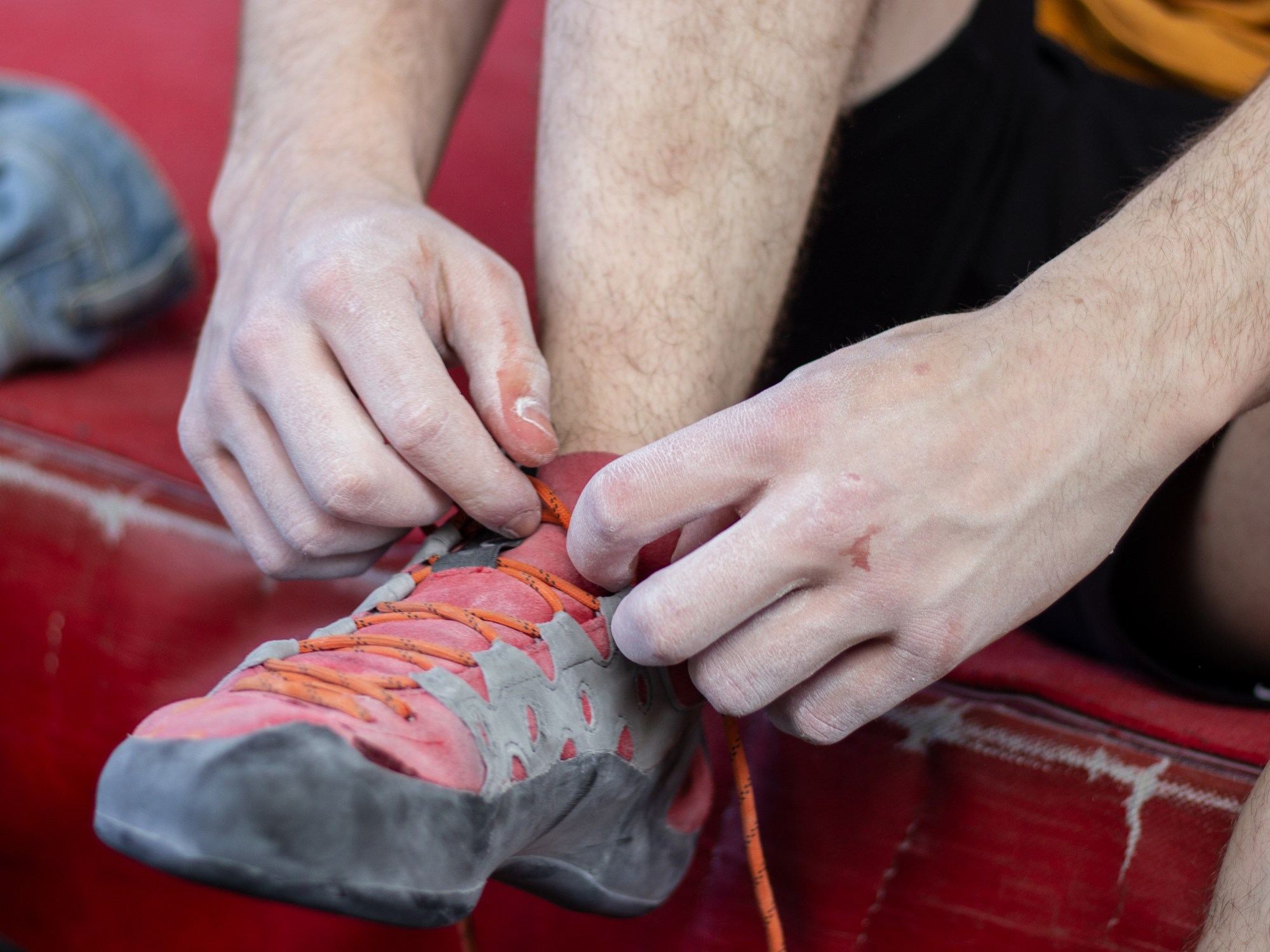
Photo by Holly Webb
This post is a collection of some of the articles I have been reading for secondary source material for my project. I decided to make a note of everything I might use here:
https://www.quora.com/Why-has-bouldering-and-climbing-become-so-popular-in-the-past-10-years
Climbers opinions online.
- “Bouldering is also something you can do completely on your own, eliminating the need for you to show up with a dedicated partner and you can still easily meet people and talk still. Bouldering also has more interesting movement possible due to the problem being so condensed. So it’s more interesting, more social, requires less gear, is cheaper to produce, and you can do it whenever you want without relying on a partner.”
- “Any sport that enters the collegiate system tends to grow in popularity. Students are generally curious and being able to access such a large number of them in a rather small area generates interest. In the past 10 years, most universities in the US have been upgrading/renovating their recreational centers in an effort to attract more students. These upgraded centers more often than not include a climbing/bouldering wall. This is creating an awareness of rock climbing among a large group of young adults, which has invariably resulted in its rise in popularity.”
- “Climbing has been announced as a new sport in the next Olympics, this helps as it has raised awareness, a lot of people don’t even recognise it as a sport!”
- “I also think it has become more popular because it doesn’t take all that much effort to improve initially, but as you climb more and more, getting better is sometimes much harder which is addictive.”
Evidence that shows people are becoming more active and climbing is becoming more popular:
- “More women, older adults and disabled people and those with long-term health conditions are getting active, our latest Active Lives Adult Survey shows.”
- “Based on data gathered from November 2017-November 2018, a total of 498,100 more people (aged 16+) are meeting the Chief Medical Officer’s guidelines of doing at least 150 minutes of moderate intensity physical activity a week compared to 12 months ago. In addition to the increase in people classed as active, the number of inactive adults – those doing fewer than 30 minutes of physical activity a week – has reduced by 185,000.”
- “These figures mean that 62.6% of the adult population are now classed as active, with 25.1% now inactive.”
- “Our research also shows that enjoyment is the biggest motivator for the active.”
- “Adventure sports (hill and mountain walking, climbing and orienteering) saw significant growth.”
- Sport England Chief Executive, Tim Hollingsworth said: “People are gravitating towards activities that can fit into their busy lives, that are enjoyable and where ability doesn’t have to matter… The nation’s activity habits are changing. The sports sector must become more demand led as a result.”
Nation’s activity levels in 2018:
- “Latest figures from our Active Lives Adult Survey show 27.7 million people – 61.8% of the 16+ population in England – are active.”
- “Adventure sports has enjoyed a boost in popularity, with 337,000 more people taking part in activities such as hill and mountain walking, rock climbing, abseiling, orienteering, or high ropes.”
https://www.sportengland.org/our-work/national-governing-bodies/sports-that-we-recognise/
Sport England explain that bouldering and indoor climbing come under ‘mountaineering’. Association of British Climbing Walls (ABC) is the executive organisation for this.
Guardian article interviewing Shauna Coxsey about climbing in the Olympics:
- “As a two-times winner of the bouldering World Cup series, Coxsey is the British climber most likely to make the case for her sport at the Olympic Games in Tokyo.”
- “It’s a little bit overwhelming that climbing is going to be part of the Games,” she says. “I am still trying to get my head round it a little bit. I am working harder than ever before but it still seems crazy and surreal. But it is real and it is coming.”
- “Coxsey won her first national championship when she was nine and began competing internationally at 13. After her A-levels she decided to go professional during a gap year, a bold move in climbing, which is far from awash with money, although she now receives funding as part of the medal support plan, administered by UK Sport.”
- “Awarded an MBE in 2016, she is now the most successful British climber in history.”
https://www.theguardian.com/sport/2016/jul/16/climbing-olympics-sport-2020-tokyo-games
Guardian feature about climbing in the Olympics:
- “Anything that makes people live a healthier lifestyle is surely a good thing. This will make climbing even more popular and hopefully open it up to people who normally wouldn’t give it a go,” said the 23-year-old from Runcorn, Cheshire. “The sport has grown rapidly over the past decade, mostly with indoor climbing walls. I know there are some people who feel that crags may become overrun but I would like to see it become more accessible to everyone.”
- “But Rob Adie, competitions officer at the British Mountaineering Council, who has helped to spearhead the campaign for climbers to compete at the Olympics, said inclusion in 2020 could only be a good thing. “Climbing is such a wide-ranging sport and there are so many different facets to it such as alpine climbing or those that like to go off to the Himalayas. This is just another aspect. It is an interesting sport and it is a good thing that it will be recognised on a world stage,” he said.”
https://www.climbing.com/news/olympic-climbing-survey-15-pro-climbers-weigh-in/
Shows climbers are divided in their opinion on it being included in the Olympics 2020.
Climb2020’s opinion on why climbing should be in the Olympics:
- “Although not for the first time, making the short list to become an Olympic sport is a great opportunity. The benefits greatly outweigh any of the reservations harboured by few and for our climbing athletes, representing their country at such a momentous event will surely be one of life’s more rewarding experiences. There are many great opportunities too for the sport. Not least the opportunity for greater publicity and media exposure. Time spent under the Olympic spotlight will almost certainly draw attention and in turn lift the sport’s public profile.”
https://tokyo2020.org/en/games/sport/olympic/sport-climbing/
Official Toyko 2020 statement about climbing in the Olympics:
-
“The sport will make its Olympic debut at Tokyo 2020 and will feature three disciplines: speed climbing, bouldering and lead climbing. Speed climbing pits two climbers against each other, both climbing a fixed route on a 15-metre wall. In bouldering, climbers scale a number of fixed routes on a 4m wall in a specified time. In lead climbing, athletes attempt to climb as high as possible on a wall measuring over 15m in height within a fixed time. At the Games, each climber will compete in all three disciplines, with the final rankings being determined by the combined results.”
 webbphoto